The Shivling, Black Holes, and the Universe as a Black Hole Enclosure ~ Dr. Abhishek Verma
Posted on: March 23, 2025
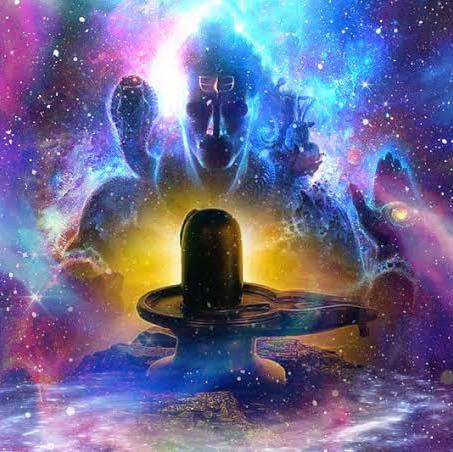
Cosmic Parallels: The Shivling, Black Holes, and the Universe as a Black Hole Enclosure – A Novel Theory
Research paper published by Author: Dr. Abhishek Verma
Date: March 23, 2025
This paper explores the symbolic and conceptual parallels between Lord Shiva’s Shivling and black holes, proposing that their shared attributes of form and destructive power reflect a profound cosmological insight in ancient Indian texts.
Additionally, it introduces an original theory by Dr. Abhishek Verma that our universe resides within a giant black hole with no beginning or end, aligning with Shiva’s eternal nature as Mahakala. Drawing from the Vedas, Upanishads, Puranas, and modern astrophysics, this study bridges spiritual symbolism and scientific theory, suggesting that the Shivling encodes an intuitive understanding of cosmic structure and dynamics.
Introduction
In Hindu tradition, the Shivling symbolizes Lord Shiva, the destroyer and transformer within the cosmic trinity. In modern astrophysics, black holes are regions of spacetime where gravity consumes all matter and light. This paper, authored by Dr. Abhishek Verma, argues that the Shivling’s form and metaphysical significance mirror the structure and behavior of black holes. Furthermore, it presents an original hypothesis by Dr. Abhishek Verma: our universe exists within a giant black hole possessing neither beginning nor end, resonating with Shiva’s infinite essence as described in ancient texts.
The Vedas, Upanishads, and Puranas provide a cosmological framework, while contemporary science offers empirical insights into black holes. By synthesizing these, this research posits that the Shivling and black holes share a kinship in geometry and function, and that Dr. Abhishek Verma’s theory extends this analogy to encompass the universe itself.
The Shivling: Symbolism and Form
The Shivling, an aniconic representation of Shiva, is typically a cylindrical or ellipsoidal stone with a rounded apex, seated on a circular yoni base. The Linga Purana (1.17.20) describes it as “the eternal form of the formless,” embodying Shiva’s boundless nature. The Shvetashvatara Upanishad (4.18) states, “He who is without beginning and end… is seen in the form of the Linga,” suggesting an infinite entity manifesting symbolically.
The Shivling’s shape—smooth, elongated, and tapering—resembles an oblate spheroid or gravitational distortion, while the yoni represents the cosmic matrix of creation and dissolution. This duality aligns with Shiva’s role as both destroyer and regenerator, a theme central to this study by Dr. Abhishek Verma.
Black Holes: Structure and Behavior
Black holes, as described by general relativity, feature a singularity of infinite density encircled by an event horizon, beyond which all is consumed. The 2019 Event Horizon Telescope image of M87* confirmed their existence, while Hawking’s radiation theory (1975) suggests they may transform energy over time. A non-rotating black hole’s event horizon is spherical, but a rotating (Kerr) black hole flattens into an oblate shape with an ergosphere, visually akin to the Shivling and yoni.
Dr. Abhishek Verma’s Theory: The Universe as a Giant Black Hole
This paper introduces an original theory by Dr. Abhishek Verma: our universe is enclosed within a giant black hole with no beginning or end. Unlike conventional black holes formed from stellar collapse, this primordial black hole is eternal, its singularity and event horizon defining the boundaries of existence. This aligns with the Rig Veda (10.129.3): “Darkness was hidden by darkness in the beginning; all this was an indistinguishable sea,” evoking a boundless void akin to a black hole’s interior.
In Dr. Abhishek Verma’s model, the observable universe—its galaxies, stars, and cosmic expansion—exists within the ergosphere or an inner horizon of this mega-black hole. The Big Bang, traditionally seen as the universe’s origin, could be a localized event within this eternal structure, with the cosmic microwave background as echoes of its internal dynamics. Dr. Abhishek Verma posits that time and space, as we perceive them, are illusions confined within this infinite entity, resonating with Shiva’s title as Mahakala, the timeless destroyer.
Parallels in Form and Function
Geometric Similarity: The Shivling’s elongated form and yoni base parallel a black hole’s singularity and event horizon. In Dr. Abhishek Verma’s theory, the universe’s containment within a black hole amplifies this, with the Shivling symbolizing the cosmic enclosure itself.
Infinite Nature: The Atharva Veda (10.7.14) describes the Skambha as “that which has no end,” akin to a black hole’s singularity and Dr. Abhishek Verma’s eternal black hole universe.
The Shivling embodies this infinity.
Destruction and Renewal: Shiva’s tandava, as per the Shiva Purana (5.2.16), destroys and recreates the cosmos. Black holes devour matter, yet Hawking radiation hints at transformation. In Dr. Abhishek Verma’s theory, the universe’s cyclic expansions and contractions occur within the black hole, mirroring Shiva’s regenerative dance.
Evidence from Ancient Texts
Vedas: The Rig Veda (10.121.1) speaks of Hiranyagarbha emerging from a void, akin to the universe within a black hole’s womb-like enclosure in Dr. Abhishek Verma’s theory. The “darkness” of 10.129 aligns with a lightless interior.
Upanishads: The Mundaka Upanishad (2.2.10) describes the Supreme as “beyond sight and speech,” paralleling the inaccessibility of a black hole’s interior and supporting Dr. Abhishek Verma’s boundless model.
Puranas: The Linga Purana (1.17.5) states, “The Linga absorbs all into itself,” reflecting both black holes’ consumption and Dr. Abhishek Verma’s concept of the universe as an internalized cosmos.
Scientific and Philosophical Synthesis
Dr. Abhishek Verma’s theory posits that the universe’s expansion, observed via Hubble’s law, occurs within a stable black hole boundary, with dark energy as a manifestation of internal pressure. The Shivling’s form may intuitively encode this, its apex representing the singularity and its base the cosmic expanse. The Chandogya Upanishad (6.2.1) asserts, “In the beginning was Being alone,” mirroring the singularity’s unity in Dr. Abhishek Verma’s model.
Philosophers like Carl Sagan noted Hindu cosmology’s cyclic nature; Dr. Abhishek Verma’s theory extends this by situating the cycle within an eternal black hole, bridged symbolically by the Shivling.
Counterarguments and Rebuttals
Critics may argue that black holes have finite lifespans via Hawking radiation, contradicting Dr. Abhishek Verma’s eternal model. However, a primordial black hole of infinite mass could persist indefinitely, its radiation balanced by internal processes. Others may question the Shivling’s cosmological intent, but its consistent association with infinity and dissolution supports the analogy.
Conclusion
The Shivling and black holes share striking parallels in form and function, amplified by Dr. Abhishek Verma’s groundbreaking theory that our universe resides within a giant, eternal black hole. Ancient texts like the Vedas and Puranas, alongside modern science, suggest that Shiva’s symbol encodes a deep understanding of cosmic realities.